
Introduction
Choosing the right company structure is the single most consequential decision you will make when setting up a business in the UAE. Get it right and you have a lean, tax-efficient vehicle that lets you operate freely in your target market. Get it wrong and you may find yourself restricted from trading directly with UAE clients, paying unnecessary costs, or required to restructure a year into operations.
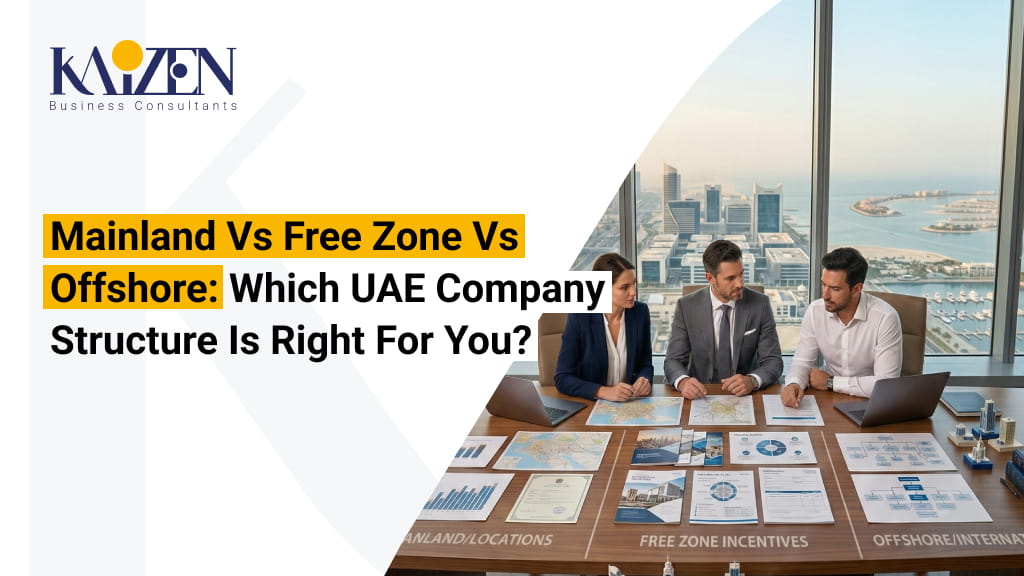
The UAE offers three primary structures: Mainland, Free Zone, and Offshore. Each has distinct advantages, limitations, and cost profiles. This guide breaks down the key differences so you can make an informed decision — or have an informed conversation with Kaizen’s company formation team.
Mainland Companies
What Is a Mainland Company?
A mainland company is registered with the Department of Economic Development (DED) of the relevant emirate — most commonly Dubai, Abu Dhabi, or Sharjah. Mainland companies can conduct business across the entire UAE, including directly with the government and the local private sector.
Key Advantages
- No restrictions on doing business anywhere in the UAE
- Can bid for government contracts
- Can open offices or branches anywhere in the UAE
- 100% foreign ownership now permitted across most business activities following the 2021 Commercial Companies Law reforms
- Access to the full UAE banking ecosystem
Key Considerations
- Generally higher setup and annual renewal costs than free zones
- Requires a physical office address in most cases
- Subject to 9% Corporate Tax on taxable income above AED 375,000
- Compliance requirements are typically more comprehensive
Best For
Businesses targeting the UAE domestic market, companies requiring government contracts, and service businesses that need to work freely across all emirates.
Free Zone Companies
What Is a Free Zone Company?
Free zones are designated economic areas governed by their own regulatory authorities, separate from the mainland DED. There are over 40 free zones in the UAE, each designed around specific industries or business types. Well-known examples include DMCC (commodities and trading), DIFC (financial services), IFZA (general business), and Dubai South (aviation and logistics).
Key Advantages
- 100% foreign ownership (this has always been the case in free zones)
- Simpler and often faster setup process
- Can qualify for 0% Corporate Tax on qualifying income (with conditions)
- Some zones offer very competitive all-inclusive license packages
- No requirement for a local service agent
- Many zones allow virtual office or flexi-desk arrangements
Key Considerations
- Cannot trade directly with UAE mainland companies without a distributor or mainland branch
- Must operate within the scope of activities permitted by the free zone
- Corporate Tax exemption is conditional — not automatic
- Banking can be more complex depending on your zone and nationality
Best For
Import/export businesses, consultancies, tech companies, trading firms, and any business whose primary market is international rather than domestic UAE.
Offshore Companies
What Is an Offshore Company?
Offshore companies in the UAE (most commonly formed through JAFZA, RAK ICC, or ADGM) are legal entities that cannot conduct business within the UAE. They are used as holding vehicles, for international trading, asset protection, or estate planning purposes.
Key Advantages
- Very low annual maintenance costs
- No requirement for physical presence or employees
- Effective for holding UAE real estate or shares in other companies
- Strong privacy and asset protection
Key Considerations
- Cannot conduct business in the UAE
- Cannot obtain UAE residency visas
- Not suitable as a primary operating entity
Best For
Holding structures, international businesses using the UAE as a base for global operations, and investors seeking to hold UAE assets in a tax-efficient vehicle.
Head-to-Head Comparison
| Feature | Mainland | Free Zone | Offshore |
| Business within UAE | Yes | Via branch only | No |
| 100% foreign ownership | Most activities | Yes | Yes |
| Corporate tax 0% | No | Qualifying income | Generally yes |
| UAE residency visas | Yes | Yes | No |
| Government contracts | Yes | No | No |
| Setup cost (approx.) | AED 15,000 – 50,000+ | AED 8,000 – 30,000 | AED 5,000 – 15,000 |
Which Structure Should You Choose?
There is no single right answer — the best structure depends on your business model, your target clients, your tax situation, and your long-term plans. Here are the most common scenarios we advise on:
- Selling products or services to UAE businesses and consumers → Mainland
- Running an international consultancy or trading operation from Dubai → Free zone
- Holding shares in other businesses or UAE property → Offshore
- Wanting maximum flexibility with a growing team and UAE client mix → Mainland with a free zone subsidiary
Get Professional Advice Before You Commit
Choosing the wrong structure can cost significantly more to correct later than getting it right up front. At Kaizen Business Consultants, we have helped hundreds of entrepreneurs and investors select and set up the right company structure for their specific goals across all UAE free zones and mainland jurisdictions. Explore our full company formation service in Dubai to see how we support every stage of the process.
Talk to the Kaizen team before you register — book your free setup consultation today.