

Introduction
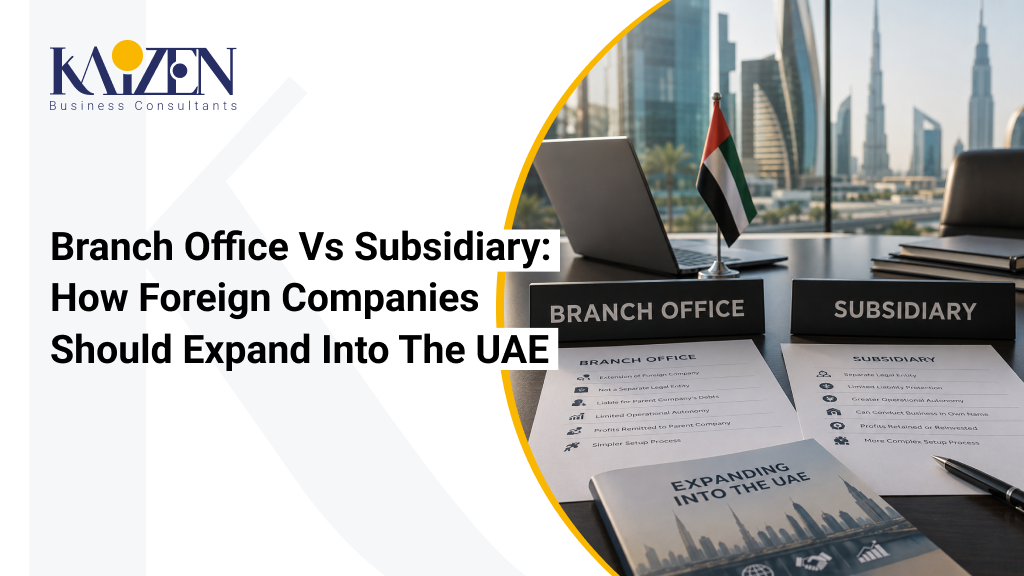
Foreign companies looking to establish a UAE presence face a fundamental structural decision early in the process: set up a branch office of the parent company, or incorporate a new subsidiary entity in the UAE. The two options look similar on the surface, both allow a foreign business to operate in the UAE, but they differ significantly in liability, ownership, tax treatment, and long-term flexibility. This guide breaks down the practical differences to help foreign companies choose the right structure. Our Company Formation Consultants in Dubai support foreign businesses through this decision on a regular basis.
What Is a Branch Office?
A branch office is a direct extension of the foreign parent company, rather than a separate legal entity. It operates under the same legal identity as the parent, carrying out activities within the scope of what the parent company is licensed to do in its home jurisdiction. A UAE branch does not have its own independent shareholders or share capital, since it is not, legally speaking, a distinct company at all.
What Is a Subsidiary?
A subsidiary is a separate, independently incorporated UAE legal entity, typically a Limited Liability Company on the mainland or an equivalent structure in a free zone. While it may be wholly or majority owned by the foreign parent company, it exists as its own distinct legal person under UAE law, with its own share capital, its own board or management structure, and its own separate legal identity.
Key Difference 1: Legal Liability
This is the single most important distinction between the two structures. Because a branch office is not a separate legal entity, the foreign parent company remains fully and directly liable for all obligations, debts, and legal claims arising from the branch’s UAE activities. There is no legal separation between the branch and the parent.
A subsidiary, by contrast, provides a genuine liability shield in most cases. As a separate legal entity, the subsidiary’s liabilities generally remain contained within the subsidiary itself, protecting the parent company’s other assets from claims arising out of the UAE operation, except in cases involving fraud, gross negligence, or specific personal guarantees given by the parent.
For foreign companies entering a new market with operational or commercial risk, this liability distinction alone is often enough to settle the decision in favour of a subsidiary.
Key Difference 2: Scope of Permitted Activity
A branch office is generally restricted to conducting the same activities as its parent company is licensed for in its home country. It cannot easily expand into new lines of business that fall outside the parent’s existing scope without amending the parent’s own licensing, which can be a slow and complex process depending on the home jurisdiction.
A subsidiary, as an independent UAE entity, can be licensed for whatever activities are appropriate for the UAE market, regardless of what the parent company does elsewhere. This gives considerably more flexibility for foreign companies wanting to adapt their offering, add new services, or pivot their UAE activities over time.
Key Difference 3: Ownership Structure
A branch office has no shareholders of its own. It is wholly and directly controlled by the parent company as an extension of that company. A subsidiary can be structured with multiple shareholders if needed, whether that means the foreign parent alone, a joint venture with a local partner, or a combination of investors. This flexibility matters for foreign companies planning to bring in local partners, UAE-based investors, or other stakeholders as part of their UAE expansion strategy.
Key Difference 4: Corporate Tax Treatment
Both branch offices and subsidiaries are generally subject to UAE Corporate Tax on their UAE-sourced income. However, the way profits are calculated and reported differs. A branch is generally taxed on the income attributable specifically to its UAE activities, requiring a clear allocation of profit between the branch and the wider parent company. A subsidiary, as a separate taxable person, is taxed on its own standalone financial results as an independent UAE entity, which is often more straightforward to calculate and defend, particularly where the FTA scrutinises how profit has been allocated to the UAE branch.
Key Difference 5: Ease of Exit
Winding down a branch office is generally a simpler process than liquidating a subsidiary, since there is no separate legal entity, share capital, or independent shareholder base to formally dissolve. For foreign companies testing the UAE market on a shorter-term or exploratory basis, this can be a meaningful practical advantage.
Which Structure Should You Choose?
A branch office tends to suit foreign companies that want a straightforward, lower complexity UAE presence, are confident in the commercial and legal environment they are entering, and plan to operate strictly within the scope of their existing parent company licence. It also suits companies exploring the market on a more temporary or limited basis, where the simpler exit process is genuinely valuable.
A subsidiary tends to suit foreign companies planning a substantial, long-term UAE presence, particularly where local commercial risk needs to be contained separately from the parent, where the UAE entity may need to operate outside the parent’s existing licensed activities, or where local partners or additional investors may eventually be brought into the UAE operation.
Practical Setup Considerations
- Both structures require submission of parent company documents, including a certificate of incorporation, board resolution approving the UAE expansion, and often notarised and attested corporate documents from the home jurisdiction
- Branch offices on the UAE mainland typically require a National Service Agent in certain emirates, depending on the specific activity
- Both structures can be established within free zones as an alternative to mainland registration, subject to the free zone’s own rules on branch versus subsidiary structures
- Banking, visa sponsorship, and office leasing requirements apply to both structures, though the documentation trail for a branch often needs to reference the parent company more extensively
How Kaizen Can Help
Our Business Setup Services Dubai team advises foreign companies on whether a branch office or a subsidiary is the right structure for their specific expansion plans, then manages the full registration process, including document attestation, licensing, and banking introductions. Once established, our bookkeeping service providers in the UAE and corporate tax consultants continue supporting the entity with ongoing compliance as it grows.
Speak to Kaizen about the right structure for your company’s UAE expansion.