
Introduction
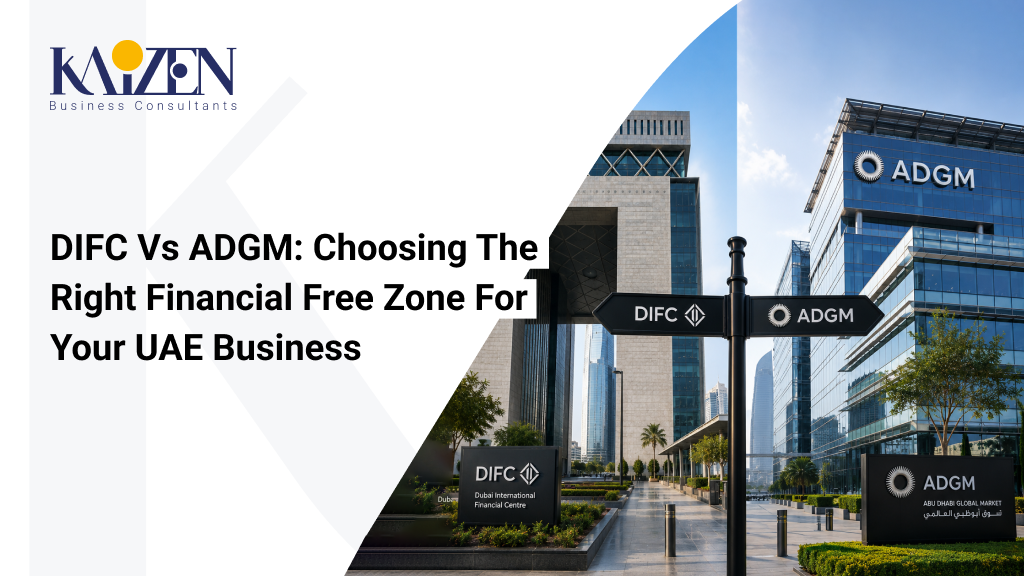
For financial services firms, holding companies, and internationally minded businesses, two UAE jurisdictions stand apart from the rest: the Dubai International Financial Centre, known as DIFC, and Abu Dhabi Global Market, known as ADGM. Both operate under English common law, both host their own independent courts, and both have built reputations as sophisticated, internationally trusted business environments. Choosing between them is rarely about which is objectively better. It is about which fits your specific business, sector, and growth plans. Our Company Formation Consultants in Dubai regularly guide clients through exactly this decision.
What Makes DIFC and ADGM Different From Other UAE Free Zones?
Unlike most UAE free zones, which operate under UAE civil law with their own licensing rules layered on top, DIFC and ADGM are true common law jurisdictions. Each has its own independent legal system, its own courts, and its own regulator, modelled closely on English commercial law. This makes both jurisdictions particularly attractive to international investors, financial institutions, and businesses accustomed to common law legal frameworks, since contracts, corporate governance, and dispute resolution operate in a familiar and predictable way.
DIFC: Overview
- Established in 2004, DIFC is the more mature of the two jurisdictions and has built a deep concentration of financial services firms, from global banks and asset managers to fintech startups and family offices. Key features include:
- Regulated by the Dubai Financial Services Authority (DFSA) for regulated financial activities
- Home to one of the largest concentrations of hedge funds, private equity firms, and wealth managers in the region
- A well-established foundations regime, widely used for succession planning and asset protection structures
- Located within Dubai, giving businesses proximity to Dubai’s broader commercial ecosystem and international airport connectivity
- A large and active professional services community, including law firms, auditors, and consultants experienced in DIFC structures
ADGM: Overview
Established in 2013, ADGM is younger but has grown quickly, positioning itself with particular strength in fintech, digital assets, and asset management. Key features include:
- Regulated by the Financial Services Regulatory Authority, FSRA, known for a proactive, innovation-friendly approach to emerging sectors such as digital assets and virtual banking
- A strong and growing foundations and family office ecosystem, actively marketed as a wealth management hub
- Located within Abu Dhabi, aligning with the emirate’s broader sovereign wealth and long-term investment focus
- Generally regarded as offering a more accessible, streamlined licensing experience for newer or smaller financial services entrants
- A dedicated regulatory sandbox framework that has attracted several fintech and digital asset businesses specifically for that reason
Head to Head Comparison
- Legal system: both operate under English common law with independent courts
- Location: DIFC sits in Dubai, ADGM sits in Abu Dhabi
- Regulatory focus: DIFC has deeper roots in traditional financial services and asset management, ADGM has built particular strength in fintech and digital assets
- Market maturity: DIFC benefits from two decades of ecosystem development, ADGM offers a newer, faster-growing environment
- Foundations and family offices: both jurisdictions offer robust foundation regimes, with ADGM marketing itself especially aggressively toward family offices in recent years
- Cost and setup experience: costs are broadly comparable between the two, though specific licence types and activities can shift the comparison either way
- Professional services ecosystem: DIFC currently has a larger, more established base of law firms, auditors, and advisors familiar with its specific regulatory framework
Which Jurisdiction Suits Your Business?
For established financial institutions, funds, and firms wanting the deepest, most mature ecosystem with the broadest peer group of similar businesses nearby, DIFC is often the natural choice. Its long track record and dense professional services community reduce friction for businesses that need specialised legal, audit, and advisory support close at hand.
For fintech businesses, digital asset ventures, or newer financial services entrants looking for a more accessible entry point and a regulator known for engaging closely with emerging business models, ADGM is frequently the better fit. Family offices in particular have been drawn to ADGM in recent years, partly due to its foundations regime and partly due to Abu Dhabi’s broader positioning as a long-term wealth hub.
Beyond regulatory fit, practical factors also matter. A business whose founders, clients, or partners are based primarily in Dubai may simply find DIFC more convenient day to day, while a business with closer ties to Abu Dhabi’s government, sovereign wealth funds, or major corporates may find ADGM the more natural base.
What Kind of Businesses Actually Need DIFC or ADGM?
It is worth being clear that DIFC and ADGM are not the right choice for every business. They are specifically designed for regulated financial services activities, professional services firms serving that sector, family offices, and holding structures wanting a common law foundation regime. A general trading company, an e-commerce business, or a consultancy with no financial services component will usually find a standard free zone such as IFZA, Meydan, or DMCC considerably more cost-effective and better suited to its actual activities.
Setup Considerations for Both Jurisdictions
- Regulated activities require formal licensing approval from the DFSA or FSRA, which involves a more detailed application process than a standard commercial trade licence
- Non-regulated holding and special purpose vehicle structures can generally be set up with a lighter touch process in either jurisdiction
- Both jurisdictions require a physical presence within the relevant centre, ranging from a full office to a smaller flexi-desk arrangement depending on licence type
- Ongoing compliance obligations, including audited financial statements, apply in both jurisdictions and should be factored into the overall cost of maintaining the structure
How Kaizen Can Help
As experienced Business Setup Services Dubai providers, Kaizen Business Consultants advises clients on whether DIFC, ADGM, or a standard free zone structure best fits their specific activity and regulatory profile, then manages the formation process end to end. For financial services and holding structures, our team also coordinates with our corporate tax consultants to make sure the Corporate Tax position of the chosen jurisdiction is fully understood before you commit.
Talk to Kaizen about whether DIFC or ADGM is the right jurisdiction for your business.