

Introduction
Of all the VAT concepts UAE businesses get wrong, the reverse charge mechanism is among the most common. It applies silently, often without an invoice showing any UAE VAT at all, which is precisely why so many businesses miss it. Import a service from a supplier based outside the UAE, and you may have a VAT obligation even though the supplier never charged you any tax. This guide explains exactly how the reverse charge mechanism works and when your business needs to apply it.
What Is the Reverse Charge Mechanism?
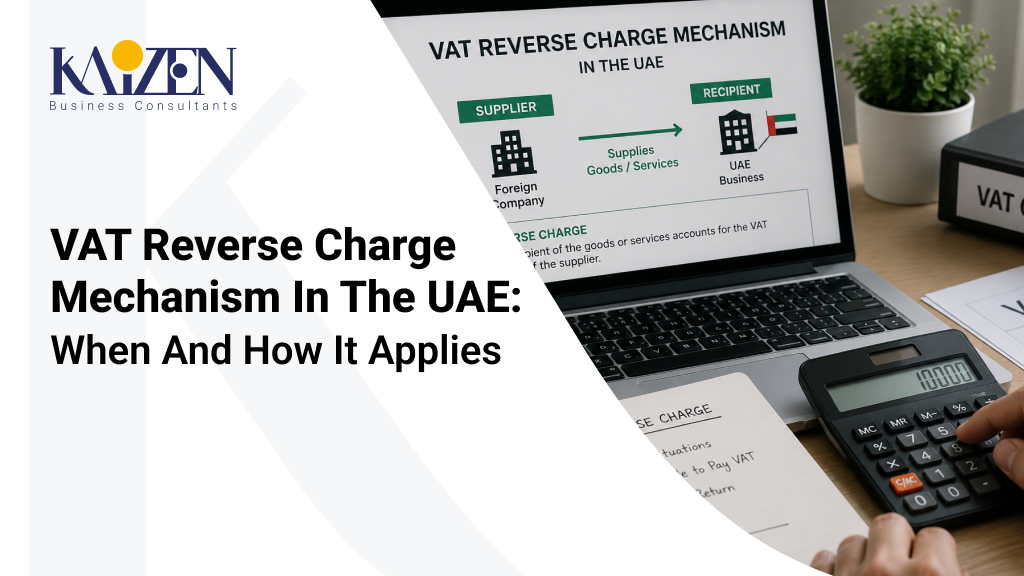
Under normal VAT rules, the supplier charges VAT on a sale and accounts for it to the tax authority. The reverse charge mechanism flips that responsibility. Instead of the supplier charging VAT, the recipient of the goods or services is responsible for self-accounting for the VAT, declaring both the output tax and, where eligible, the corresponding input tax on the same VAT return.
The mechanism exists primarily to capture VAT on transactions where the supplier has no presence in the UAE and cannot practically register for and charge UAE VAT.
When Does Reverse Charge Apply?
The reverse charge mechanism most commonly applies in the following scenarios:
- Import of services from a supplier located outside the UAE, where the recipient is a VAT registered business in the UAE
- Import of goods into the UAE by a VAT registered business, in most cases handled through the customs declaration process rather than a supplier invoice
- Certain domestic supplies specifically designated by the Cabinet to fall under reverse charge, such as specific transactions in the gold and precious metals sector
- Transactions involving crude oil and refined petroleum products between registered businesses
The most frequent scenario for typical SMEs is the import of services, covering things like software subscriptions from foreign providers, consulting fees paid to overseas advisors, digital advertising spend with international platforms, and licensing fees paid to a foreign parent or related entity.
How Reverse Charge Accounting Works in Practice
When a UAE VAT registered business receives a service from a supplier outside the UAE, it must:
- Determine the value of the service received, in AED, based on the invoice or agreed contract value
- Calculate output VAT on that value at the applicable rate, typically the standard 5 percent rate
- Declare that output VAT on the VAT return, even though the foreign supplier never charged it
- Simultaneously claim the equivalent amount as input VAT on the same return, provided the expense relates to taxable business activity and is otherwise eligible for recovery
For most fully taxable businesses, this results in a net nil cash impact because the output VAT declared is offset by an equal input VAT claim. The obligation is not really about paying additional tax in most cases. It is about correctly reporting the transaction on the VAT return.
Why This Matters Even When the Net Effect Is Nil
Because the reverse charge often results in no net VAT payable, many businesses assume it is not worth worrying about. This is a mistake. The FTA still expects reverse charge transactions to be correctly identified, valued, and reported on the return, separately from standard domestic supplies. A VAT return that fails to reflect reverse charge transactions is considered inaccurate, even if the net tax position happens to be unaffected.
The risk becomes considerably more significant for businesses that are not fully taxable, such as those making exempt supplies. In these cases, the input VAT on the reverse charge transaction may not be fully recoverable, meaning there is a genuine net VAT cost that must be correctly calculated and paid.
Common Reverse Charge Mistakes
- Failing to identify foreign supplier invoices as falling under reverse charge, particularly for recurring software or subscription expenses
- Applying reverse charge to purchases from UAE based suppliers, where it does not apply
- Not declaring reverse charge transactions on the VAT return because no VAT appeared on the original invoice
- Businesses with partial exemption incorrectly recovering full input VAT on reverse charge transactions
- Confusing reverse charge on imported services with the separate customs process for imported goods
Reverse Charge on Imported Goods vs Imported Services
It is worth drawing a clear distinction here. Imported goods are generally handled through the UAE customs declaration process, where VAT is calculated and accounted for as part of the import clearance, often using the business’s Tax Registration Number linked to the customs system. Imported services do not pass through customs at all, since there is no physical shipment, which is exactly why they are more easily overlooked. The obligation to self-account for VAT under reverse charge still applies, but it depends entirely on the business correctly identifying the transaction from the supplier invoice itself.
How to Stay on Top of Reverse Charge Compliance
- Review all foreign supplier invoices and subscriptions on a regular basis to identify reverse charge transactions
- Set up your accounting system to flag and calculate reverse charge VAT automatically where possible
- Maintain clear documentation showing the reverse charge calculation for each relevant transaction
- Review your input VAT recovery position carefully if your business makes any exempt supplies
- Include reverse charge transactions as a specific checkpoint in your VAT return preparation process, rather than relying on suppliers to flag them
How Kaizen Can Help
Our Tax Consulting Services in Dubai include a full review of reverse charge exposure as part of VAT return preparation and health check engagements, making sure imported services and goods are correctly identified and reported. We also coordinate with our bookkeeping service providers in UAE team to build reverse charge checks directly into your monthly accounting process, rather than treating it as a once a quarter exercise.
Contact Kaizen to review your foreign supplier transactions and confirm your reverse charge VAT position.